
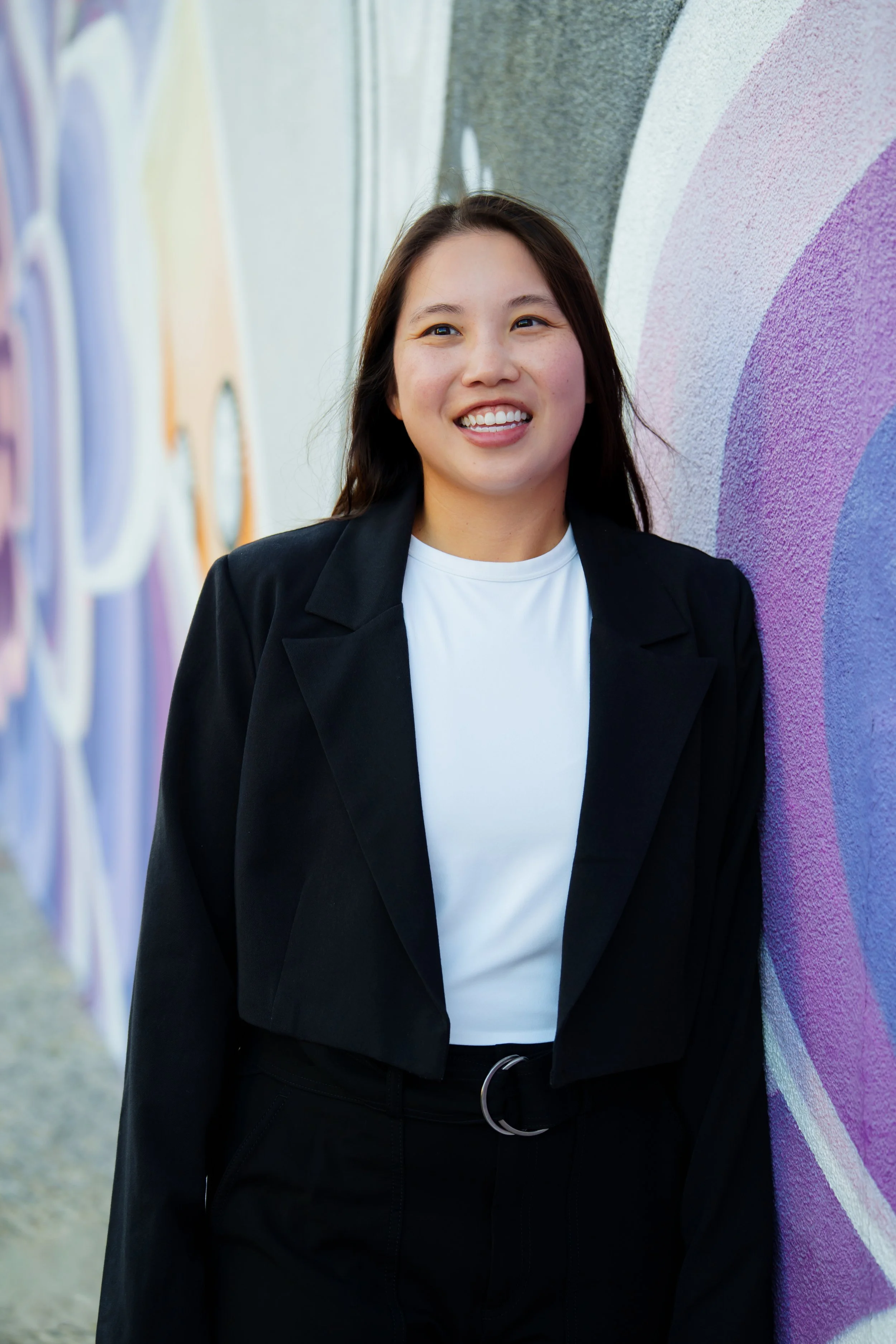
Photo credit: Diane Rose
The creative process does not follow a linear path, and the end results are often quite unexpected. When Chieko Shimizu Fujioka, Moeko MACHIDA, and I had first met over tea to discuss the possibility of creating a group exhibition together, we had been drawn to each other’s shared inspirations from nature and life cycles. Chieko’s capturing of nature’s subtle complexities in her glass mosaic and Moeko’s quiet attention to the mysterious phenomena surrounding lives in her Japanese pigment paintings resonated with my exploration of the feedback loop between people and their environments. However, we hadn't quite envisioned how we would actually create a cohesive exhibition, and we attempted to talk our way into an exhibition concept. Moeko, the only one of us with formal training in fine art, recognized our inability to use words to express visual ideas and instructed each of us to go out into the world with a Polaroid camera to capture what inspired us. She wanted to use those visual moments as the basis of our exhibition together. We also decided we wanted to create a collaborative piece of artwork together, with Moeko advising us to keep experimentation as the main purpose of creating a collaborative piece together. The three of us had never worked together before, but Moeko knew that we all held ourselves to high standards of creating “capital A” Artwork. She implored us to see the process of creating a collaborative piece as the end goal, not the artwork itself. She wanted all of us to let go of all expectations and have an openness to the whole experience.
In our gatherings, I think I had expressed, in not so many words, that I had been struggling with the experimental process of being an artist. Transitioning from a career as a data scientist in health policy research, I struggled to embrace the inefficiency and inexactness of the creative process. Being a statistician and data scientist was creative in its own way: trying out multiple statistical models or data transformations to learn something new from a dataset or using different data visualization techniques to best convey information, but there was usually an end product that produced results. The creative process felt inefficient to me at times because I felt like I had wasted time when I worked on something that didn't turn into a presentable piece of art. I had read many books about creativity that all touted the concept of "doing it for the process", but hearing Moeko directly tell me that the process was the goal finally had me internalizing the concept.
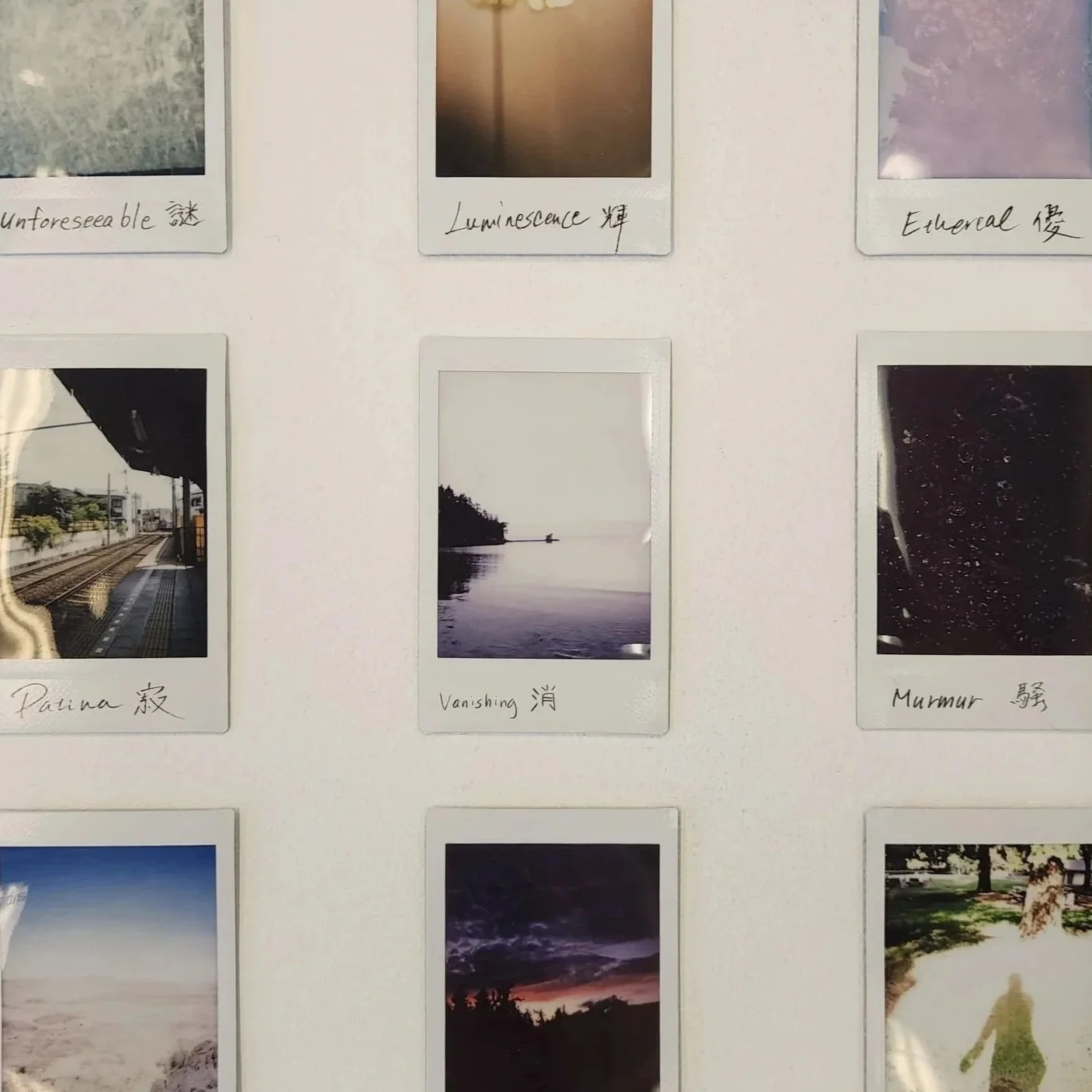
Polaroid pictures by Margaret Luo, Moeko MACHIDA, and Chieko Shimuzu Fujioka.
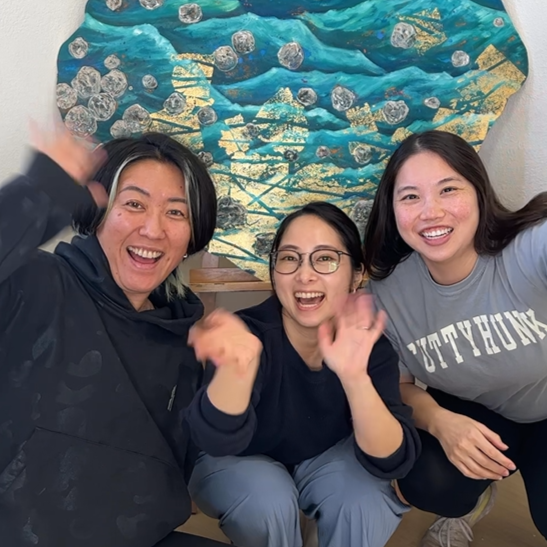
Chieko Shimizu Fujioka, Moeko MACHIDA, Margaret Luo, Interwoven Elements 交, Oil, mineral pigment, acrylic, gold leaf, glass on board. Photo credit: Shimizu Fujioka
Chieko, Moeko, and I did end up creating a beautiful collaborative piece after many trials and errors, and for the first time, the process didn’t feel inefficient to me. There was an overall sense of joy and excitement working together; we were all curious to see what each artist would create and how we could play off of each other’s creativity. I felt free while contributing my part of the piece, the first layer of turquoise and phthalo blue waves in movement. Through the process of sharing our Polaroid pictures, picking out our favorites, and intentionally adding kanji that made sense in both Japanese and Chinese to express how the captured images made us feel, I felt like the three of us developed a deeper understanding of each other. Trust was built through our constant communication about our hopes for the piece throughout the process. I felt that I could rely on my collaborators to build upon the piece in a way that preserved each of our voices while also creating something new.
Coming off the high of creating a completely unique piece of collaborative artwork, I was inspired to explore outside of my comfort zone for my individual piece. While I had initially started a painting earlier in the year that explored a zoomed-in view of the movement of ocean waves on an expansive canvas, I had many fits and starts when working on the painting. I know that sometimes I need to be patient with myself when working on a new project, but I realized that I found this particular painting upsetting each time I returned to it. I was hyper-focused on the result. I realized I had to take a step back and pivot. I didn't want whatever I produced to be the result of a tortured experience.
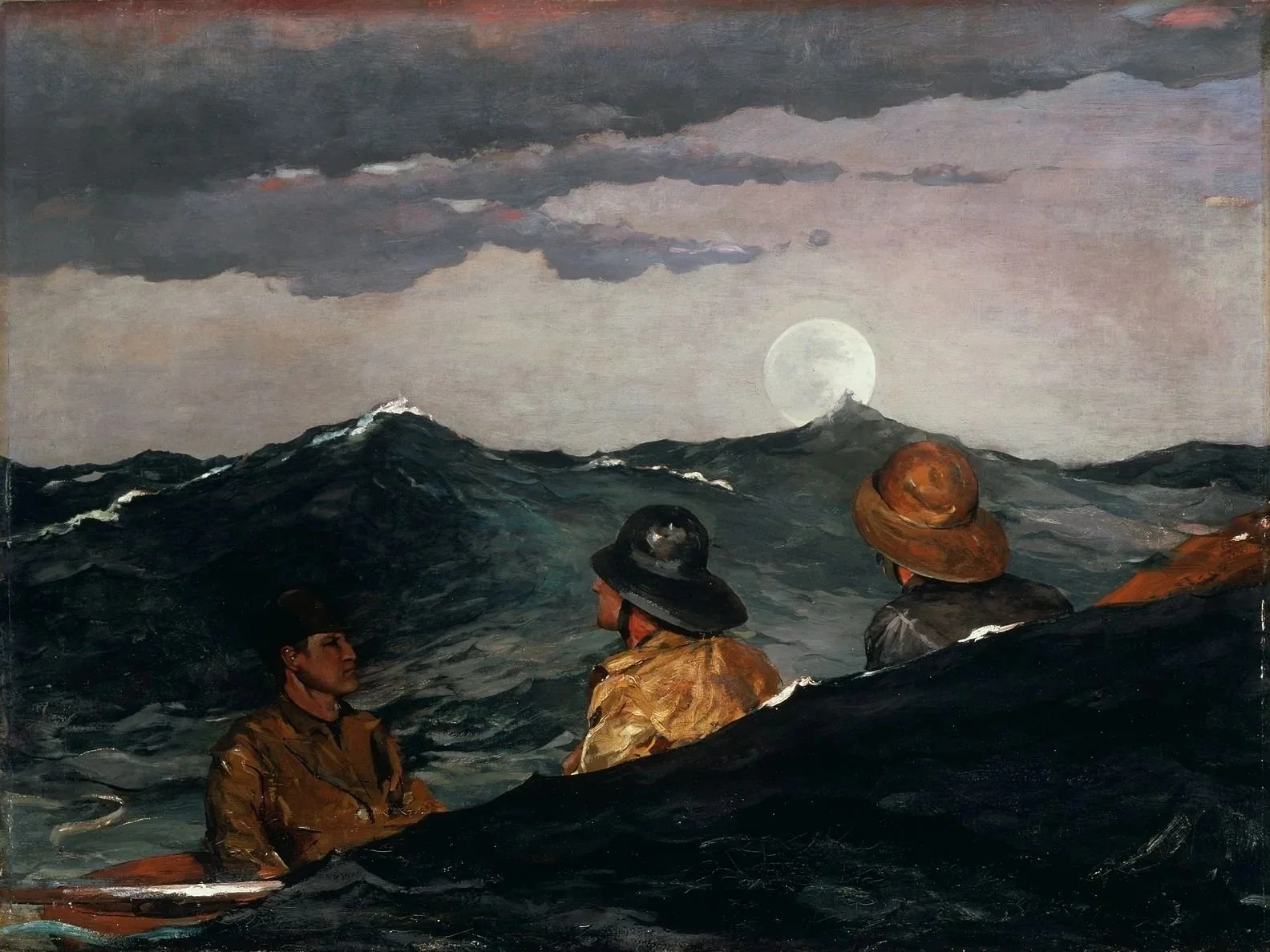
Winslow Homer, Kissing the Moon (1904), Oil on canvas.
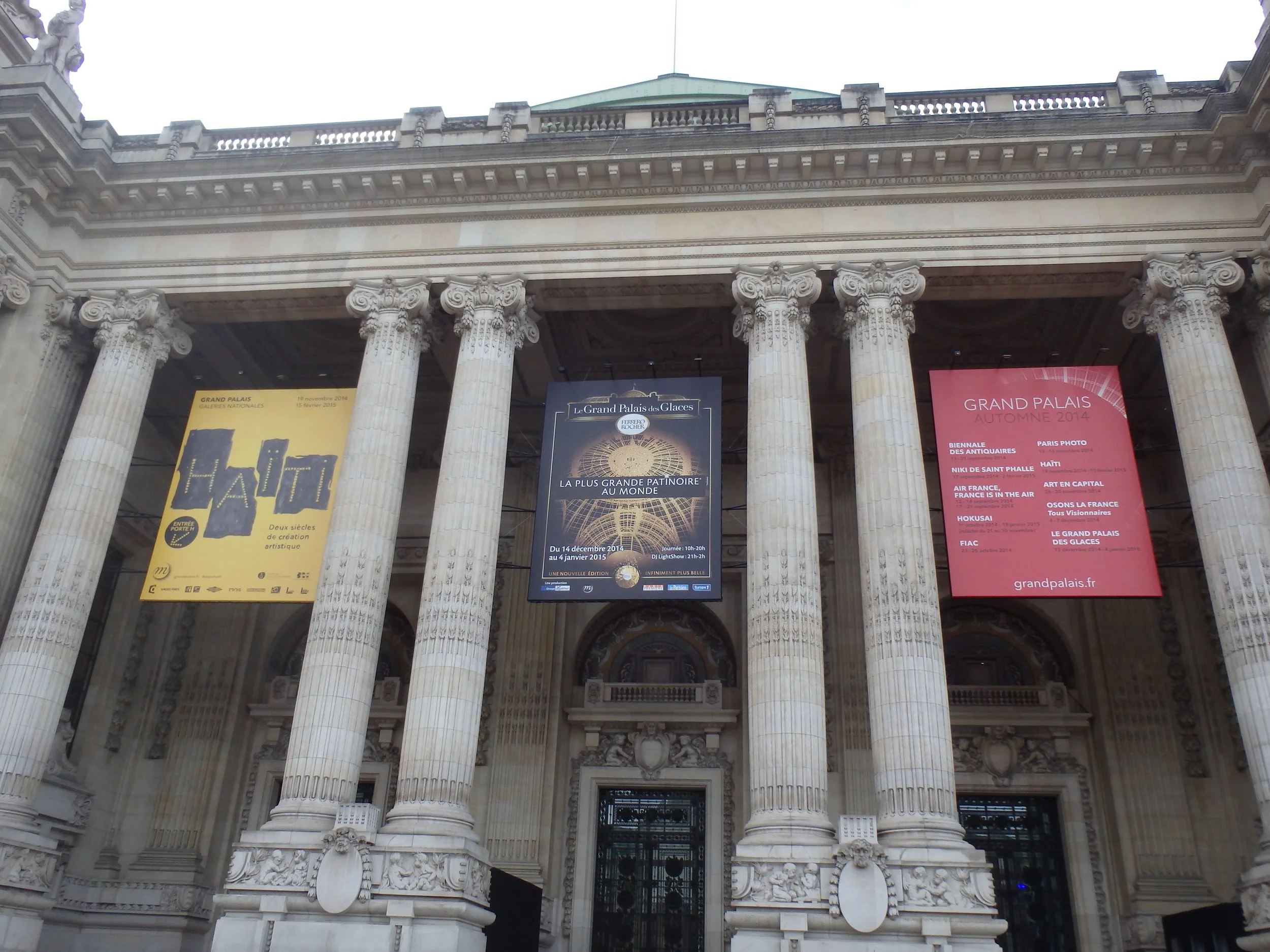
Banners outside the Grand Palais, December 11, 2014. Photo credit: Margaret Luo
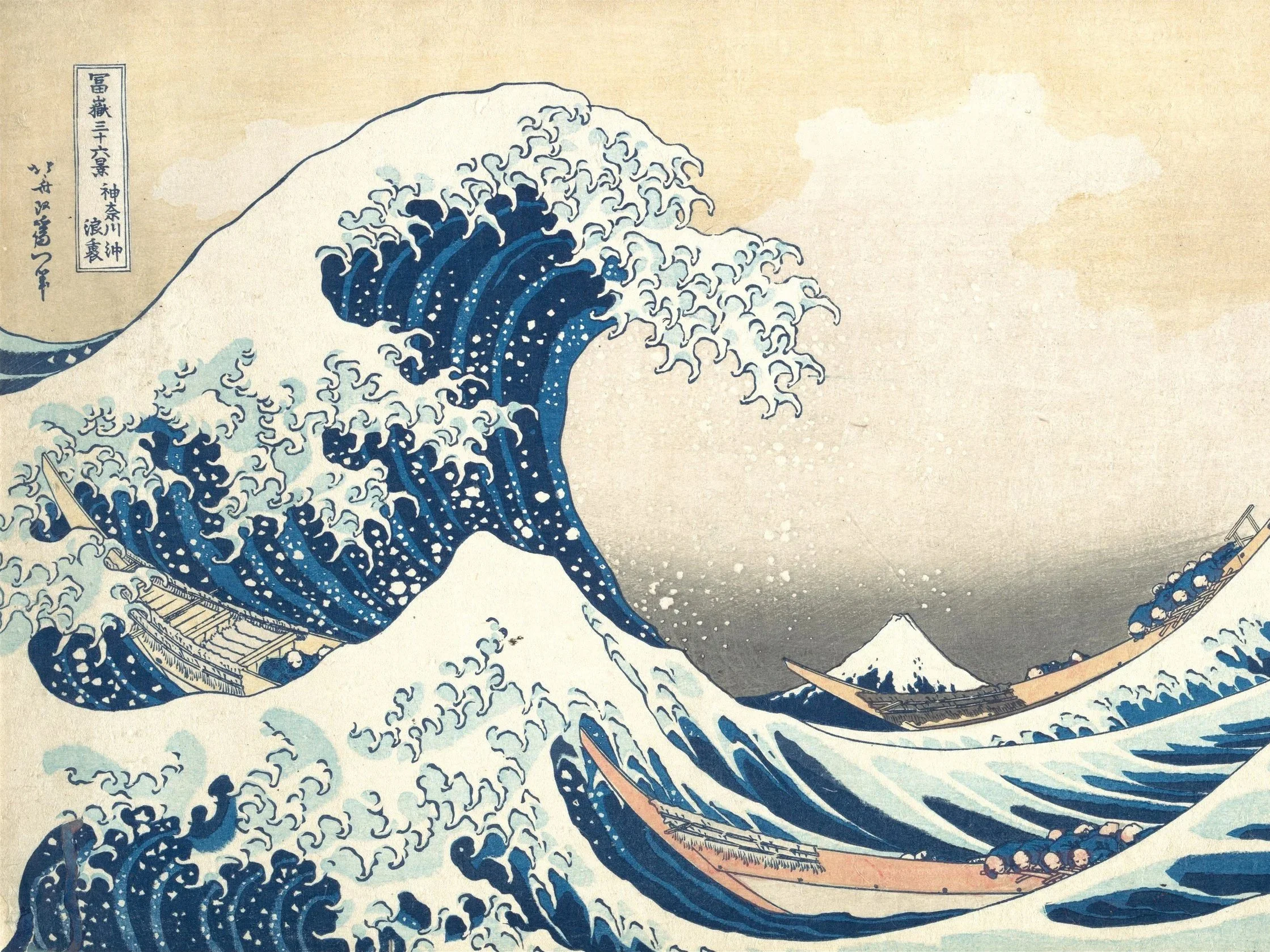
Katsushika Hokusai, The Great Wave off Kanagawa (1831), Ukiyo-e (woodblock print).
So I put down the paint brushes, took some time away from the studio, and borrowed a range of art books from the library. Earlier in the year, I had visited my alma mater, Swarthmore College, and met with my art professor from the only painting class I took in higher education. In classic professorial fashion, he had recommended that I look at how Winslow Homer painted water and how Catherine Murphey captured details at scale. Flipping through John Wilmerding’s book on Winslow Homer, looking through the color plates, I was enthralled by Homer’s Kissing the Moon, 1904. I learnt from the text that Homer had traveled to Paris from 1866 to 1867–and between discussions of art historians debating the importance of Homer’s trip to Paris on his career as an artist and a later analysis on Kissing the Moon that describes how the painting calls to Japanese prints such as that of The Great off Kamagawa by Hokusai–a memory arose. I visited Paris in the winter of 2014 during a semester of study abroad and by chance visited a Hokusai exhibition at the Grand Palais. The memory was faint, but I remembered being so enthralled by the artworks in the exhibit, I had hit my face on one of the glass walls protecting the artwork when I had attempted to take a closer look at a wood block print.
At the time, I hadn't known that I would end up pursuing a career in the arts; I had thought I was going to get a job in finance or get an advanced degree in a STEM field (I ended up doing both). But I had always been drawn to art and especially artwork that featured water. It was too much of a coincidence to be led in this meandering way to not create an artwork inspired by Homer and Hokusai for my individual piece for this group exhibition. And I had once again relearned the intention behind Moeko’s words when she advised us to see the process as the goal.
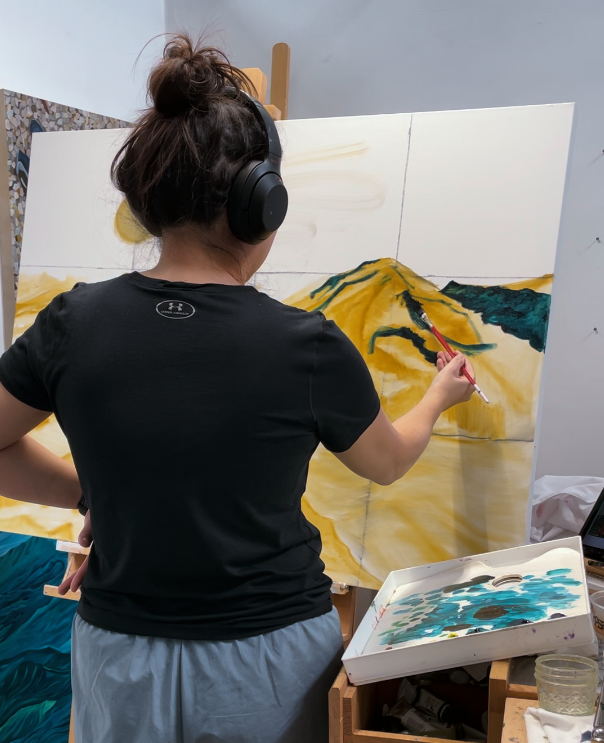
Margaret Luo painting Great Waves Off the Moon 月玻 in her studio. Photo credit: Margaret Luo
So I ended up putting aside my first attempt and started fresh on a new canvas. I wanted to use the same color palette as the collaborative piece while incorporating the moments of light from Chieko’s glass mosaic and the organic shapes Moeko had layered onto the artwork. The organic shapes looked like pieces of the moon, tying back to Homer’s Kissing the Moon. Studying the collaborative piece alongside Homer’s paintings and Hokusai’s prints, I wanted to create a painting that had a dreamlike, abstract quality. I also wanted to recreate the sharp cliff features of traditional Chinese Shanshui (山水, which literally translates to “mountain water”) ink paintings that depict natural landscapes. Through creating Great Waves Off the Moon -月波-, I worked on integrating a variety of inspirations from artists past and present.
I’m grateful for the year-long process that has culminated into the Ebb & Flow exhibition. Unexpected moments can be challenging for me, which is often (if not almost always) at odds with the creative process. The irony of how I attempt to plan for novel experiences, like planning a group exhibition, is not lost upon me. I’m grateful for the trust that Moeko, Chieko, and I shared as collaborators, which helped me be more receptive to new ideas. As an emerging artist in the first years of my career, I learned valuable lessons from their experience such as the importance of knowing when to let go of control and to embrace the nonlinear path as a creative. I was able to see how my experiences in the past can come forward to the present and integrate into my works, underlying the importance of living a wide life full of exploration and unexpected moments.
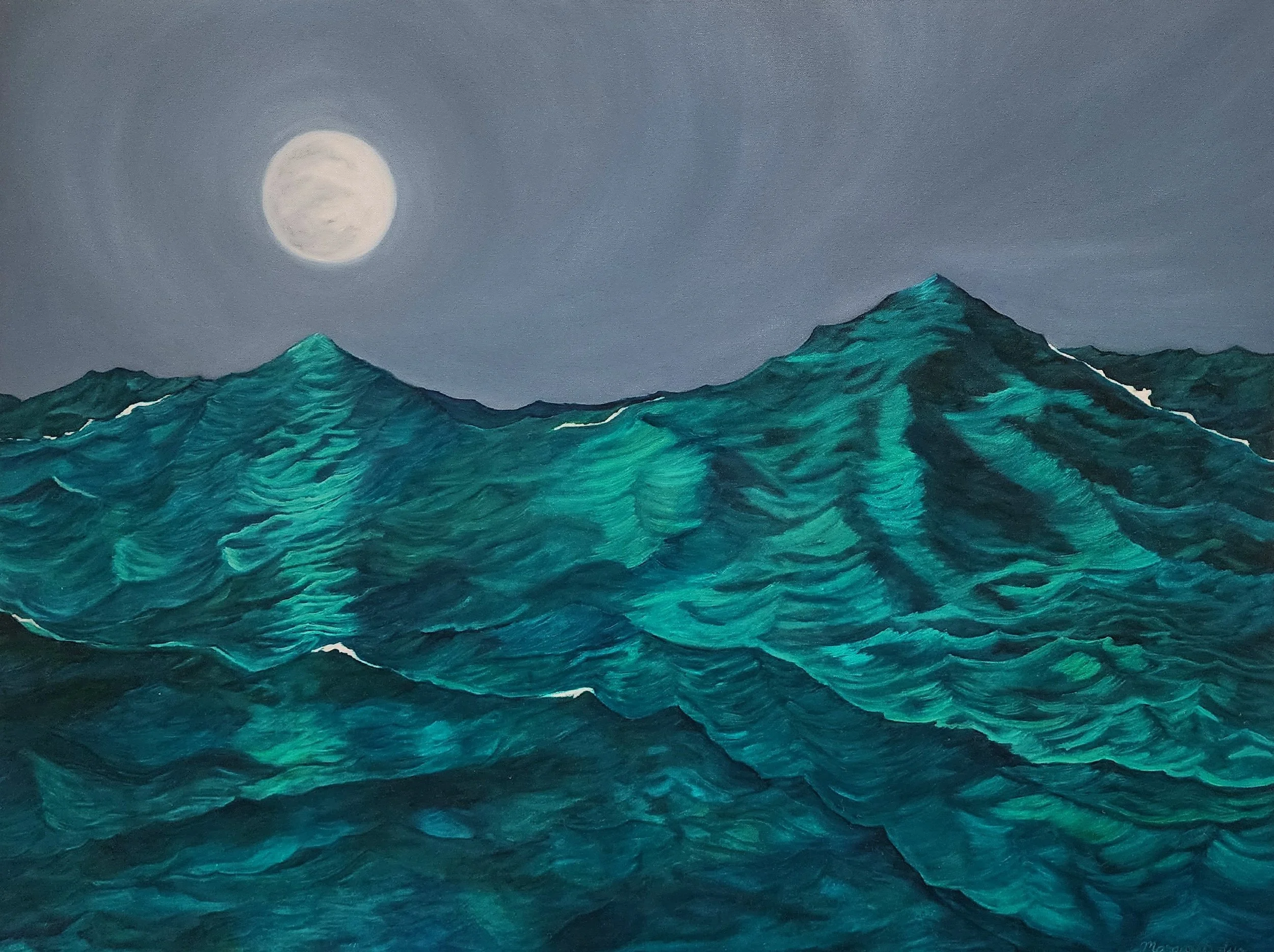
Margaret Luo, Great Waves of The Moon -月波- (2025), Oil on canvas.
